
In the latter part of 2010 I took notice a few big-name investors (such as Warren Buffett and Bill Gates) were quietly making massive bets on clean energy while simultaneously betting against the long-term future of oil and gas. This caught my interest so I started researching. After buying a small library of books and diving deep into the research, I discovered the concept of peak-oil and the model that predicts it, the Hubbert Curve, created by geophysicist M. King Hubbert.
The idea is that oil production for a region follows a bell-shaped curve. First there is the discovery and rapid growth, then peak production, and finally a decline as reserves become harder and more expensive to extract. To back up the integrity of this model, Hubbert famously predicted in the 1950s that U.S. oil production would peak around 1970 and he was remarkably accurate.
These big-name investors were betting on the decline of oil. And I became convinced these investors were right. Then I had another thought:
“If oil and gas eventually decline… what benefits from that?”
Electric vehicles!
Back in 2011, I remember telling a friend that EVs were eventually going to replace gasoline cars. He told me about a weird little company called Tesla that had recently gone public. He showed me the website. I saw the car and thought, I want this one day. So, I bought stock only a few months later. It turned out to be one of the best investments I ever made.
But over the last few years, I’ve started getting that same feeling again. This time, it wasn’t about energy or transportation. It was about labor. Specifically… the house cleaning industry.
Around 2021, the time Tesla announced Optimus (e.g. their humanoid robot project), something clicked in my head. I own house cleaning companies. I understand the economics of cleaning. I understand repetitive labor. I understand margins. And suddenly I realized something uncomfortable:
If humanity eventually creates affordable humanoid robots capable of safely navigating homes, then house cleaning may become one of the first major service industries to experience large-scale automation (along with cooking, lawn maintenance, gardening, and any other task homeowners either do themselves or hire companies like mine).
I knew it sounds ridiculous so I kept quiet. But then I remembered something important; most people also laughed at EVs. And that’s what led me down this rabbit hole.
The more I became familiar with robotics, AI, machine vision, battery technology, automation economics, labor shortages, and humanoid robots, the more convinced I became that this shift is not science fiction. It is likely coming far faster than most cleaning companies realize. The real question isn’t whether if robots will eventually clean homes. The real question is:
When?
And perhaps more importantly, what happens to the cleaning industry when they do?
Core Prediction
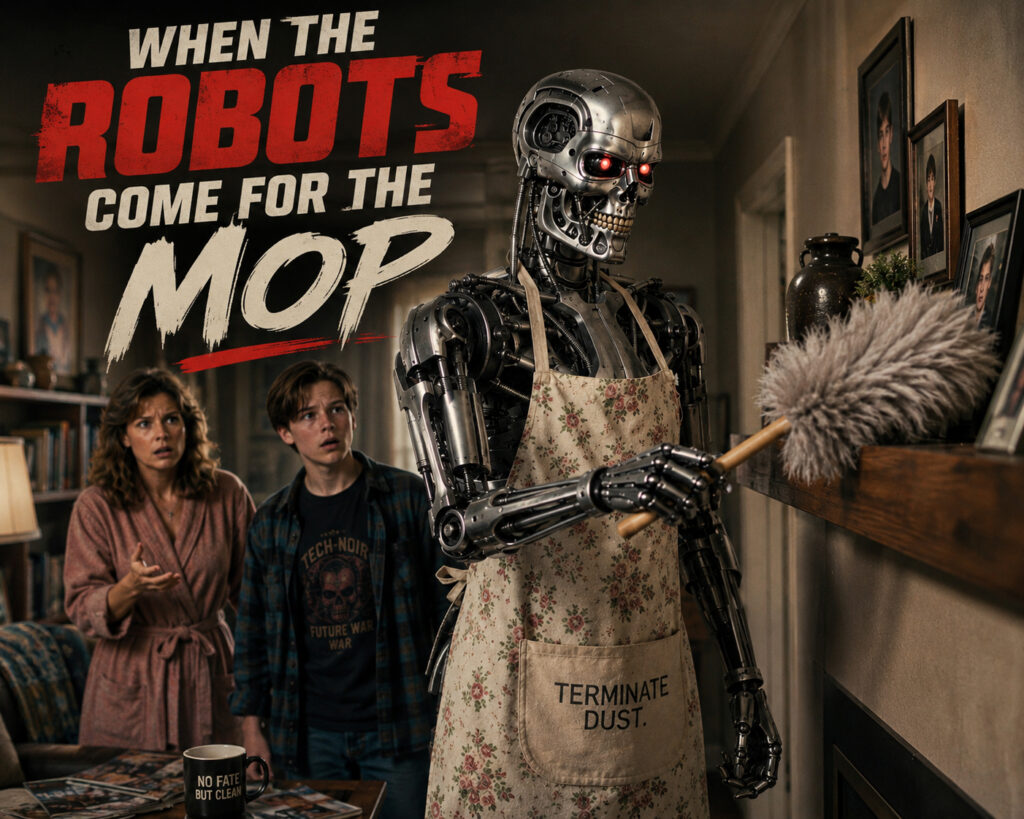
Robots will not kill house cleaning all at once. They will eat it in layers.
First, they take over floor maintenance: vacuuming, mopping, simple bathroom/kitchen surface routines. Then they take over basic recurring cleans. Last, and much later, they threaten deep/detail cleaning, because detail cleaning is not just “cleaning.” It is judgment, dexterity, damage avoidance, customer trust, clutter interpretation, and knowing that the weird thing on the counter is either trash, medicine, or evidence in a marital dispute.
My best estimate:
| Cleaning Type | Robot Capability Becomes Useful | Mainstream Threat to Maid Services |
|---|---|---|
| Vacuuming/mopping floors | Already here | Already happening |
| Commercial floor cleaning | Already here | 2026–2030 |
| Basic home tidying + simple cleans | 2028–2032 | 2030–2035 |
| Carpet cleaning | 2029–2032 | 2033–2038 |
| Move-out cleaning | 2032–2038 | 2035–2042 |
| Full recurring maintenance clean | 2032–2038 | 2035–2040 |
| Detail/deep cleaning | 2037–2041 | 2040s |
Move-out cleans are particularly interesting because they are more structured and less emotionally sensitive than occupied homes. Empty apartments and homes are almost ideal environments for robots because of the open floor space, predictable layouts, less clutter, no pets/kids, fewer fragile personal belongings, and the repetitive tasks.
Large apartment complexes and property management firms will likely become some of the earliest adopters of robotic cleaning systems because the economics are extremely attractive.
Carpet cleaning may also get automated surprisingly quickly because it is already equipment-heavy. A carpet cleaning technician today is already partially operating as a machine operator. Once AI navigation, hose management, obstacle avoidance, and automated stain detection improve, robotic carpet cleaning becomes much easier than full-service home cleaning.
Ironically, one of the hardest things for robots may not be cleaning dirt. It may be understanding humans. A robot can identify a stain. But can it identify sentimental clutter, fragile family heirlooms, a child’s school project, medication, tax documents, expensive makeup, or a spouse’s “DO NOT TOUCH THIS” pile? That is where the timeline stretches.
Why This Is Coming
The robotics market is no longer science fiction. The International Federation of Robotics reported that professional service robot sales reached almost 200,000 units in 2024, up 9%, with staff shortages as a major driver. Cleaning robots were one of the growing categories.
Consumer home robots are also already normalizing the idea. Around 20 million service robots for consumer use were sold in 2024, with domestic robots leading the category.
Robot vacuum and mop markets are exploding globally, and consumers are slowly becoming comfortable with autonomous devices wandering around their homes.
But today’s robot vacuums are not “maids.” They are Roombas with delusions of grandeur. Useful? Yes. Replacing our professional home cleaner, Delfina? Not even close.
Who Will Probably Make the Cleaning Robots?
The winners will likely come from three groups:
1. Humanoid robot companies: Tesla Optimus, Figure AI, Unitree, Agility Robotics, Apptronik, and Chinese humanoid makers. Figure is already positioning Figure 03 for household tasks, saying it is designed for unpredictable home environments and everyday work. Tesla’s Optimus has been repeatedly discussed around a long-term target price of roughly $20,000–$30,000, although consumer availability and real-world capability remain unproven.
2. Existing cleaning robotics companies: Tennant, SoftBank Robotics/Whiz, Brain Corp, and commercial floor-care companies. Tennant already markets robotic floor scrubbers as tools that free employees for detailed cleaning and higher-value tasks. SoftBank’s Whiz is already a commercial autonomous vacuum aimed at offices and industrial settings.
3. Home appliance giants: iRobot, Roborock, Dreame, Ecovacs, Dyson, Samsung, LG, Shark, and future Apple/Amazon-style smart-home players. These companies will likely dominate “non-humanoid” cleaning: floors, mopping, dust detection, air quality, maybe window cleaning.
My bet: commercial cleaning gets automated by specialized robots first; residential cleaning gets disrupted later by humanoid bots bought by families to take over the plethora of house tasks they had previously delegated out to home services companies.
So, as a house cleaning service owner, I’ve been keeping an eye on the use of bots for commercial purposes.
Likely Robot Costs
Near-term humanoids will be expensive. Even if Tesla eventually hits the famous $20k–$30k target, early units could cost more, and the bigger issue will be service, insurance, repairs, training, and liability.
More realistic adoption path:
| Period | Likely Cost Model | Who Buys First |
|---|---|---|
| 2026–2028 | $40k–$100k+ per capable humanoid, mostly pilots | Factories, warehouses, labs |
| 2028–2032 | $25k–$60k or lease model | Commercial cleaning, eldercare, large facilities |
| 2032–2038 | $20–$30k or possibly a $500–$1,500/month lease | Wealthy households, property managers |
| 2038+ | Mass-market selling | Middle/upper-middle-class homes |
I think families will buy the humanoid robots. However, some postulate tThe biggest shift will not be purchase price. It will be Robot-as-a-Service: “Don’t buy the robot, subscribe to the robot.” Eitherway, once a robot costs less to buy or per month than a recurring maid service, the economics get dangerous for us owners of home cleaning companies. Very dangerous.
What Robots Will Do First
They will start with the boring stuff such as floors, vacuuming, mopping, dusting, repetitive commercial jobs, trash runs, and maybe laundry folding in controlled environments. However they will struggle with cluttered homes, kids’ rooms, pet mess, fragile items, antique furniture, marble countertops, stainless steel, grout, shower glass, and “Please clean around my husband’s emotional-support pile of receipts.”… at first.
That is why basic recurring cleaning is vulnerable before deep cleaning.
Basic Cleans vs. Detail Cleans
A basic clean is predictable. A deep clean is chaos wearing yoga pants. A robot can learn, “vacuum this floor”, “mop this tile”, “wipe this counter”, and “clean this sink.” But detail cleaning involves, “is this object valuable?”, “will this chemical damage the surface?”, “is this dust, mold, food, makeup, or a substance I do not want to know about?”, “should I move this, clean around it, or pretend I never saw it?”
That is why deep cleaning survives longer. The more a job requires judgment, dexterity, trust, and accountability, the longer humans remain valuable.
Should You Sell a House Cleaning Company? And If So, When?
My answer: Personally, I don’t plan on selling my house cleaning companies because they will remain viable (and profitable) past the best time to sell. Why give up all those years of cash flow for a smaller, lump sum if you sell? Also, I have a feeling we will be able to reinvent ourselves and remain compeitive through the transition to an AI-robotic world.
However, for those who are thinking of selling, the best window is probably before robots become part of buyer due diligence, but after your company is large, systemized, recurring-revenue heavy, and tech-forward. For a strong residential cleaning company, I’d watch 2028–2032 as the likely sweet spot.
Why?
The industry is still healthy now. The U.S. residential cleaning services market is estimated around $18.8 billion in 2026, with hundreds of thousands of businesses, and forecasts still show growth. Another 2026 market report estimates the U.S. residential maid services market at about $17 billion, driven by aging consumers and time-pressed households.
But once buyers start believing humanoid robots will materially reduce labor demand, traditional maid companies may get lower multiples unless they can show they are positioned to benefit. So the move is not necessarily “sell tomorrow.” It is, build like you are selling in 2029–2031.
That means increase recurring revenue, reduce owner dependence, build management depth, document SOPs, improve margins, strengthen reviews and local SEO, build customer data, develop add-on services robots cannot easily replace, and possibly start experimenting with robot-assisted cleaning before competitors do. The company that sells best will not be “a maid service.” It will be a local home-care platform with recurring customers, trusted staff, strong brand, and automation upside.
The Bigger Opportunity: Robot-Assisted Cleaning
Here is the twist: robots may not destroy cleaning companies first. They may make the best cleaning companies more profitable. Imagine a two-person cleaning team with a robot assistant: Robot vacuums and mops while cleaners handle kitchens/bathrooms. Robot does repetitive floor work. Human staff focus on detail work, quality control, customer interaction, staging, and upsells.
That could improve margins and reduce physical strain on employees. So, the future cleaner may become more like a home-care technician: Robot supervisor. Quality-control specialist. Customer service rep. Surface-care expert. Organizer/light home manager. Elder-support/home-support worker. The lower-skill parts of the job get automated. The human parts become more valuable.
Despite this thought, in the long term the robots will win out, taking all the human tasks.
What Happens to Cleaning Staff?
Some staff will be displaced eventually, but not overnight. The more likely path is job transformation with future roles may including robot cleaning operator, in-home quality inspector, detail cleaning specialist, senior home-care assistant, organization and decluttering specialist, move-in/move-out specialist, biohazard/odor/remediation tech, and luxury home concierge cleaner.
The best cleaners will not be replaced first. The least reliable, lowest-skill, “just push the mop around” work gets replaced first. The most trusted staff, the ones customers request by name, will remain valuable far longer.
But for how long?
A Strategic Recommendation for You
Do not run from robots. Brand yourself as the company that understands both human care and future tech. A winning tag ine could be:
“Bots remove dust. People earn your trust”
or maybe:
“Tech may clean and repair. Humans still show care.”
The second one works especially well if your cleaning company eventually evolves into a full-service home care company, one that handles not just cleaning, but also lawn care, gardening, running errands, meal preparation, and other household services. Expanding into broader home services like this is probably the smartest long-term move since the robots can be programmed to do any househole chore.
Then quietly prepare for a future where your company owns the customer relationship, the recurring billing, the local brand, the staff training, the robot deployment, and the quality guarantee. Because when robots become the future of cleaning and home services in general, customers will still ask: “Who do I trust to send this expensive little metal butler into my house?” That company could be yours.
Final Prediction
At first, robots will not wipe out the cleaning industry. They will split it: a) Cheap, basic, repetitive cleaning gets automated. b) High-trust, detailed, judgment-heavy cleaning becomes premium.
For a while, humans will still dominate the more complicated side of home services because people will trust humans more than machines inside their homes. A robot may be able to vacuum a floor, but customers will still want a person handling fragile items, deep cleaning, organization, caregiving, and anything requiring judgment or emotional intelligence. But that phase won’t last forever.
Later, transportation will become far cheaper and more convenient because they will be able to summon a self-driving car, similar to an Uber or Lyft, than to own one. People won’t need to park, drive, or even pay attention during travel. Instead, they’ll be able to work, relax, watch movies, or sleep while the car drives itself. (Side note for that last point: This could even disrupt parts of the airline industry, because for many regional trips, people may simply choose to sleep overnight in a self-driving car rather than pay for expensive plane tickets, airport parking, security lines, delays, rental cars, and hotels.)
As families save a large chunk of their money by no longer owning vehicles, many will redirect those savings toward home robotics. At first, people may rent household robots through subscription services. But eventually, as costs continue to fall, owning a highly capable humanoid robot may become as common as owning a refrigerator, dishwasher, or washing machine.
And once robots can truly do nearly everything a human can do physically such as cleaning, cooking, mowing lawns, gardening, organizing, laundry, caregiving, repairs, and more… most traditional home service industries probably will not survive in their current form.
House cleaning companies. Lawn care companies. Gardening companies. Cooking services. Even many caregiving and personal assistance roles could eventually decline dramatically once families can own a robot that works 24 hours a day, never gets tired, never calls in sick, continuously improves through AI updates, and costs less over time than hiring humans.
And once the technology becomes reliable, affordable, and socially accepted, the economics become almost impossible to compete against. That means the real danger zone for traditional maid services is probably sometime between 2032 and 2040, when investors and buyers may begin fully pricing in the long-term threat of humanoid robotics and AI-driven home automation.
Because of that, the ideal window to sell a traditional cleaning company is likely between 2028 and 2032, while the industry still appears healthy, before household robotics become mainstream, and before business valuations begin declining due to automation risk.
Ironically, the companies with the highest valuations during that period may be the ones that appear the strongest operationally right before the disruption arrives. History shows that industries are often repriced years before the disruption fully takes over. Most people only realize the future has arrived after it is already too late.

About the author: Greg Shepard is the founder of Dallas Maids, a professional home cleaning company he started in 2004 after a career in technology at IBM and Bank of America. A Baylor University graduate, he writes about entrepreneurship, business, and the observations and lessons he has picked up along the way.