
My family and I are vacationing in Vietnam, and a couple of days ago I encountered a sales process so brilliantly engineered and so psychologically aggressive that it nearly blew my marketing-degree-having mind. Now, I’ve read a small library of books about marketing, persuasion, and consumer psychology. I’ve also spent more than two decades running businesses and using some of these principles myself. But this? This was not merely selling. This was psychological choreography.
Every step appeared designed to move us closer to a purchase without ever directly saying, “You are not leaving this building until somebody buys silk.” Technically, no one can force you to buy something. But a carefully designed sales process can apply so much subtle psychological pressure that buying begins to feel like the easiest escape route. Heck, the entire experience was so finely tuned that I had to write about it here, not just because I admired the craftsmanship, but because understanding these tactics makes it easier to recognize them before you find yourself carrying home king-size silk sheets and a pair of underwear you never intended to own.
Welcome to the “Educational Tour”
Our Vietnamese guide took us to one of those tourist businesses where guides receive a “commission” when their guests make purchases. That is common in many tourist destinations, especially in developing countries and I don’t necessarily have a problem with it. Guides need to earn a living.
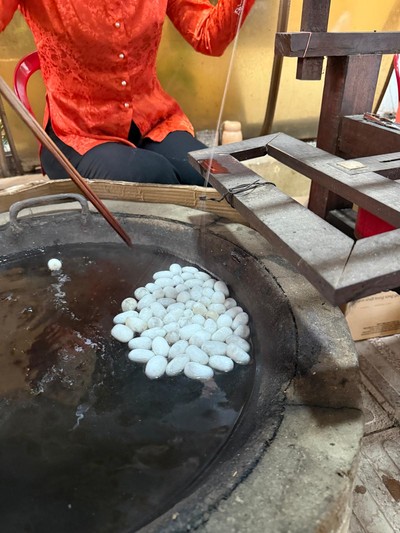
The visit was presented as an opportunity to learn how silk is made. We began with a friendly gentleman (let’s call him the Silk Guy) who showed us actual silkworms (my wife ate a boiled worm when silk guy offered… she is an adveturous foody), explained how silk thread is extracted (they extract it while boiling the cocoon… that’s why the worm was cooked), and demonstrated how the thread is woven into fabric on a loom.
It was genuinely interesting. And it was also slightly rushed. Silk Guy apparently had a schedule to keep, and that schedule involved getting us into the bedsheet room as quickly as humanly possible.
At the time, the tour felt like a pleasant free activity. Psychologically, however, it was the opening move.
The Free Tour Wasn’t Really Free
The tour acted as a gift. When someone gives us something, whether it’s information, time, entertainment, a sample (creds to my wife’s silk worm snack!), or even a cheap pen with your logo on it, we often feel an internal pressure to return the favor. Psychologists call this the norm of reciprocity.
Robert Cialdini famously discusses this principle in Influence: The Psychology of Persuasion, which remains one of the best books ever written on why people say yes. The basic idea is simple: when someone does something for us, we feel that we should do something for them. And research has found that even relatively small favors can increase compliance, while retail studies have examined how free samples can encourage purchases by creating a perceived obligation to reciprocate.
It’s the same reason a printing company might mail you a free pen bearing your company logo. You didn’t ask for it. You may not even need pens. Yet suddenly you’re thinking: “Well, these are rather snazzy. Perhaps we do need 500 of them.” I previously wrote about this in The Sneaky Power of a Free Pen.
In our case, the gift was the silk-making tour. We had received something. Now our brains were quietly waiting for an opportunity to repay it. Fortunately, Silk Guy knew exactly where we could do that.
Please Take a Seat… You’ll Be Here a While
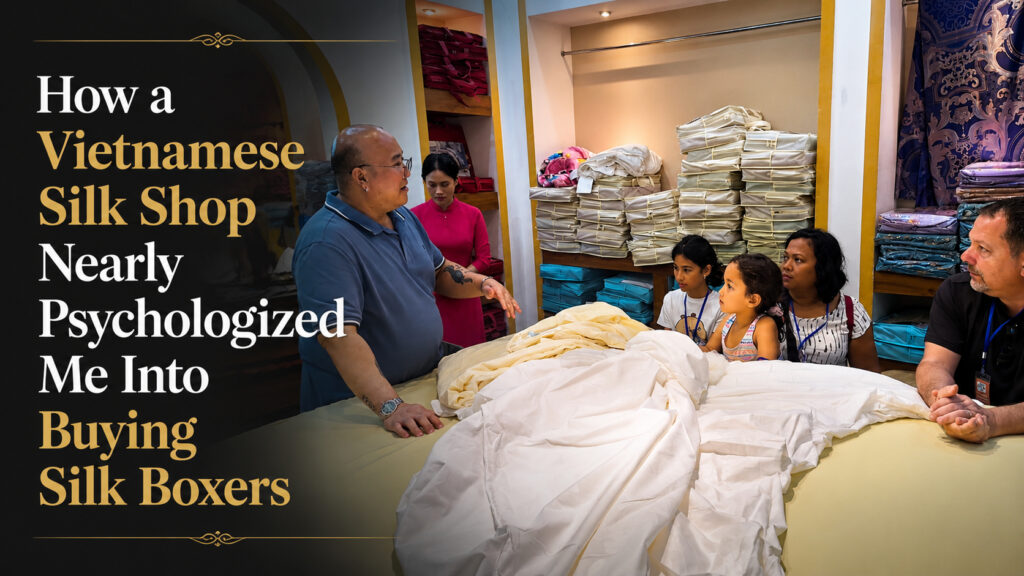
After the hasty tour, Silk Guy led us into a room filled with racks of silk bedsheets. Then he closed the door behind us. Several small wooden stools were positioned directly in front of a large presentation table. My family sat down, but I remained standing. Our Vietnamese guide immediately encouraged me to sit…. Oh, she was absolutely in on this.
The stools were not especially comfortable, but they served their purpose. Once everyone was seated in a row, facing the table, we were no longer wandering tourists. We were a captive audience. Silk Guy had now completed his transformation from friendly educator into salesperson, although he never announced the change. There was no obvious moment when the tour ended and the sales presentation began. That transition had been deliberately blurred. All I could think was, woah, that was devilishly smooth.
Lesson Two: How to Identify Real Silk
Silk Guy placed several elaborate bedsheet sets on the table (four, if I recall correctly) each featuring intricate Oriental-style designs and varying levels of quality. Then came another educational presentation.
He explained how to determine whether silk is genuine. First was the bleach test. According to him, natural silk dissolves in bleach, while polyester does not. Then came the burn test. Real silk, being a protein fibre, reportedly smells similar to burning human hair, while synthetic material behaves and smells differently.
Whether or not any tourist should begin setting fire to hotel bedding is a separate discussion. What mattered was what the lesson accomplished psychologically.
First, it implied that their silk was authentic. They did not simply say, “Our silk is real.” They taught us how to identify fake silk and then positioned their own product as the obvious authentic version. And this increased the product’s perceived value while allowing us to feel that we had reached the conclusion ourselves.
Second, it gave us another free gift. The silk-authentication lesson was useful and entertaining. That activated reciprocity again. Free tour. Free class. Our psychological tab was getting longer.
Third, it increased our investment in the process. The more time and attention people invest in evaluating a product, the harder it may become to walk away. We had already watched the silkworms, examined the loom, learned about fabric construction, and completed Silk Authentication 101. At this point, we were practically adjunct professors of silk.
Finally, the lesson smoothly carried us from education into selling. The presentation never felt like a sudden pitch. Each step naturally led into the next. Tour the factory. Learn how silk is made. Learn how to identify real silk. Examine the sheets. Choose your favorite. Buy the sheets.
The road had been carefully paved. We just had to keep walking.
He Began Teaching Us How to Care for the Sheets We Hadn’t Bought
Next, Silk Guy explained how we should wash and care for silk bedding. Notice the wording there. Not how someone might care for silk sheets. How we should care for them.
This is similar to an assumptive close: speaking as though the purchase decision has already been made and moving the customer mentally into ownership. Instead of asking: “Would you like to buy these sheets?” The conversation quietly becomes: “Here is how you will care for your new sheets.” That change encourages the customer to imagine owning and using the product. And once your mind begins imagining the sheets on your bed, it is no longer evaluating a theoretical product. It is evaluating your future sheets.
Suggestion is powerful, and people are often more susceptible to it than they realize!
Why There Were Only Four Choices
Silk Guy initially showed us only a few designs. That was intentional. Businesses often try to provide enough variety to create a sense of choice without offering so many options that customers become overwhelmed. This idea is commonly called the paradox of choice or choice overload.
When a decision becomes too complicate, especially when customers are uncertain about what they want, they may postpone choosing, feel less confident, or walk away entirely. Choice overload does not happen in every situation, but it becomes more likely when the options are complicated, the decision is difficult, or the customer does not have clear preferences. For example, Dallas Maids specializes ONLY in residential cleaning. We originally offered just THREE services: standard, deep, and move-out house cleaning. Later we added apartment, green, and carpet cleaning, bringing the grand total to six. Although, now that I’m writing this, apartment and green cleaning could be folded under standard cleaning to lessen the choices to four… [Makes mental note to reorganize the service menu one day]
Four options made the question simple: “Which of these do you prefer?” While twenty-five options might have changed the question to: “Why am I spending my vacation evaluating decorative silk peacocks?”… Naturally, I disrupted the process. I asked whether they had anything more contemporary and…. they did.
Silk Guy produced three plain sets, each in a different color. Three. Not thirty. We were permitted additional choice, but not enough choice to escape into indecision.
And Now, a Free Silk Sheet!
Finally, we were told that if we purchased the bedsheets, we would receive another sheet for free. Of course we would. The entire sales funnel had been built around giving us things and then allowing our own minds to calculate the debt. We had received a free silk-making tour, a free lesson on identifying genuine silk, free care instructions for our future silk sheets, and now a free bonus sheet with purchase. At this rate, declining to buy felt like we might be violating an international treaty.
My Wife Performed a Miraculous Escape
Somehow, despite everything, my wife calmly said: “Let’s think about it.” I was impressed. The entire process had been carefully designed to make “yes” feel natural and “no” feel awkward. Yet she managed to create a third option: not right now.
We politely stood up and prepared to leave. But Silk Guy was not finished. He guided us through another door. And suddenly we were standing inside a large shop filled with silk products. Scarves. Clothing. Accessories. Pillowcases. And, yes, silk underwear. Most of these items cost considerably less than the bedsheets. That was almost certainly no accident.
The Expensive Product Made Everything Else Feel Cheap
Once customers have considered an expensive product, lower-priced items can feel inexpensive by comparison. This is related to the anchoring effect and reference pricing.
The first significant price we encounter can influence how we judge later prices, even when the comparison is imperfect. This is why a salesperson may wait until after you purchase an expensive suit before introducing the tie. Before buying the suit, a $75 tie may sound expensive. After buying a $1,200 suit, the same tie becomes: “Well, I suppose the man needs something around his neck.”
The bedsheets established the expensive anchor. Everything in the final shop now seemed affordable. So, if we had purchased the sheets, adding a scarf or pillowcase would have felt minor. And if we had not purchased the sheets, the lower-cost products provided another purpose: they gave us a way to relieve the guilt created by the reciprocity pressure.
Our brains could say: “We didn’t buy the bedding, but these people gave us a tour, taught us about silk, and spent all this time with us. We should at least buy something.” And when I say guilt, I do not mean that Silk Guy directly accused us of anything. I mean the guilt our own minds produced after being carefully nudged at every stage. Heck, I seriously considered buying silk boxers.
I did not buy them. This may have been my greatest achievement of the trip.
I Was Far Too Excited About All of This
My wife noticed my obvious giddiness. She may have thought I had become unusually passionate about textile manufacturing. In reality, I was fascinated by the sales system and how expertly it was put together. I graduated Baylor with a marketing degree (Random fact: If you are a fan of the show Fixer Upper, I once had the pleasure of teaming up with Chip Gaines on a marketing project back at Baylor. Great guy and, sadly, he did not renovate my office while we were at it.), have read extensively about marketing, psychology, and persuasion, and have spent more than 20 years building businesses and applying some of these principles.
Yes, we proudly display all the awards we’ve won. That, incidentally, is called social proof. People are more comfortable choosing a business when they can see evidence that other people already trust and value it. So, of course we use persuasion in business. Nearly every company does. Good reviews are social proof. Guarantees reduce perceived risk. Educational content builds authority (like this article). Free estimates lower the barrier to starting a relationship. And these tools are not automatically unethical.
The ethical question is whether they help customers make informed choices or whether they are stacked together to create pressure, confusion, or a sense of obligation. That distinction also matters online. Reviews can help customers make decisions, but fabricated praise can manufacture social proof that does not really exist. And when I see cleaning companies do that, it just m makes me steam more than my carpet cleaning guy steaming your carpets. That was one of the motivation for me to write about how to spot fake reviews and the warning signs consumers should watch for. Ok, I digress (again)…
Persuasion or Manipulation?

What impressed me most was that nearly everything we experienced appeared to serve a psychological purpose.
The tour established goodwill.
The educational presentation established authority.
The authenticity lesson increased value.
The stools created a captive audience.
The limited selection simplified the decision.
The care instructions encouraged us to imagine ownership.
The bonus gift activated reciprocity again.
The expensive sheets created a price anchor.
The lower-cost shop provided a consolation purchase for anyone who resisted the main offer.
It was remarkably well constructed. But it was also uncomfortably manipulative. The difference between persuasion and manipulation often comes down to transparency and freedom. Persuasion says: “Here is why this product may be valuable to you.” While manipulation says: “Let us arrange the environment so carefully that you feel uncomfortable leaving without buying something.”
Silk Guy never physically forced us to purchase anything. But the system was designed to press nearly every psychological button available.
The Lesson
There is nothing wrong with accepting a free tour, listening to a demonstration, or enjoying a sample. There is also nothing wrong with walking away. A gift does not create a debt unless you agree that it does. And salesperson teaching you how to care for a product does not mean you have decided to buy it. A small selection may make choosing easier, but you are still allowed to choose none of the above. And the fact that a lower-priced item suddenly seems inexpensive does not mean you wanted it before someone showed you the expensive one.
The best defense against psychological pressure is simply recognizing what is happening. Just pause. step outside, compare prices, think overnight. And ask whether you wanted the product before the presentation began. Had I not recognized the psychology behind the experience, we might have left with king-size silk bedsheets, several bonus items, and an unnecessarily luxurious collection of men’s underwear. Instead, we left with our money, our dignity, and a very good blog post.
Silk Guy may not have made the sale. But as a marketer, I have to admit: The man was good.

About the author: Greg Shepard is the founder of Dallas Maids, a professional home cleaning company he started in 2004 after a career in technology at IBM and Bank of America. A Baylor University graduate, he writes about entrepreneurship, business, and the observations and lessons he has picked up along the way.