
Dallas Maids has ranked near the top of Google for many years, and we believe there is a simple reason for that: we try to earn our reputation rather than manufacture it. For more than two decades, we have done things the old-fashioned way. We clean homes, take care of customers, fix mistakes when they happen, and hope people are happy enough to tell someone about us.
Revolutionary, I know.
The reviews on our Google Business Profile come from actual customers who hired us to clean their homes. Our mission has always been to provide a place of peace for our people (e.g. our amazing customers). A clean, comfortable home our customers can retreat to after a long day of dealing with work, traffic, children, pets, laundry, and whatever mysterious substance has appeared on the kitchen floor.
Sometimes, customers reward us by sharing their experience online. Even better, they recommend us to friends and family. That is how a reputation should be built: one home, one customer, and one very relieved homeowner at a time. Unfortunately, some businesses may be tempted to take shortcuts by purchasing positive reviews or using questionable tactics to make their online reputation look stronger than it really is.
Now, I am not writing this article to publicly taddle on any particular cleaning company despite how tempting that would be to. My goal is to help Dallas homeowners recognize warning signs so they can make a more informed decision. As a business owner who has spent more than 20 years trying to provide an excellent maid service, fake reviews bother me. They are unfair to customers trying to find a trustworthy cleaning company, and they are unfair to honest businesses that work hard to earn every review they receive.
Here are some signs worth watching for.
1. A Surprising Number of “Edited” Reviews
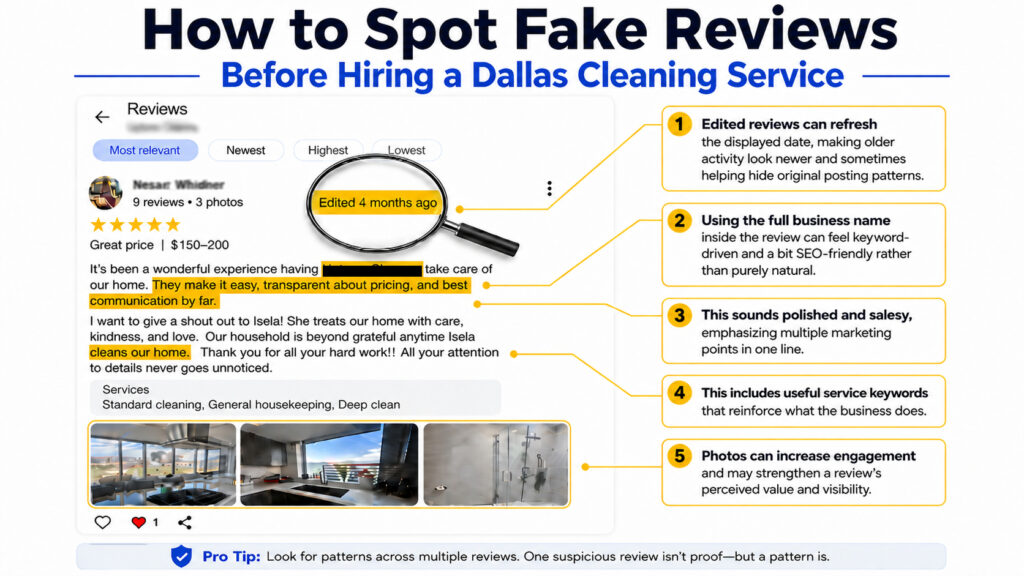
One of the biggest warning signs (if not the biggest) of late I have noticed is a business with an unusually large number of edited reviews. Customers certainly edit reviews from time to time. Maybe the company resolved a complaint, the customer wanted to add an update, or they noticed that autocorrect had transformed “cleaning crew” into “cleansing crow.” It happens. But in my experience, most customers do not regularly return months later to revise a perfectly ordinary five-star review. When a company more than just a couple of reviews marked “Edited,” it is reasonable to look a little closer. And there are a couple of nefarious reasons local cleaning companies (or the SEO agency they hired) may do this.
Review edits can also make older activity appear more recent or make the original posting pattern harder for an ordinary customer to recognize. Some SEO gurus have reason to believe recent review activity can help a business appear more active and competitive in Google Maps, thus getting ranked higher on Google maps. Unfortunetly, that may create an incentive for less ethical companies to continually refresh older reviews.
Also, edited reviews may be used to hide a review dump (see below). Because that pattern is so obvious, a less-than-ethical company might later edit those reviews to refresh the dates and make the original burst harder to spot. But tricks like this rarely stay hidden forever. Google has a habit of catching up and it is not known for its sense of humour.
So, business owners should remember: online tricks rarely work forever. Google constantly adjusts its systems to identify manipulation. A strategy that creates a temporary boost today could become a painful penalty tomorrow. Google has a looong memory, and unlike your grandmother, it is not easily distracted with cookies.
2. The Sudden Review Dump
Another classic red flag is the review dump. This happens when a business that normally receives a handful of reviews suddenly gains 20, 30, or 50 glowing reviews within a day or two. That does not automatically mean something dishonest happened. Perhaps the company ran a legitimate campaign asking recent customers to share their experiences. Maybe it sent a reminder to its entire customer list.
Still, real customer reviews usually arrive somewhat naturally over time. A giant burst of short, enthusiastic reviews (especially from accounts with unusual activity) deserves additional scrutiny. So, look through the company’s review history. Do the reviews appear steadily over months and years, or do they arrive in suspicious clusters? Also examine the reviewers themselves. If many of the accounts in the same review burst are posting reviews for businesses in cities all over the world, the pattern becomes more questionable.
One person reviewing a taco restaurant in Dallas, a dentist in Miami, a locksmith in London, and a carpet cleaner in Delhi, all before lunch, may simply be an extraordinarily busy traveler. Or perhaps not…
3. The Reviewers Do Not Appear to Live Anywhere Near Dallas
This requires a little more digging, but it can be revealing. Click on a few reviewer profiles and look at their other activity. Do they regularly review businesses around Dallas–Fort Worth, or are almost all their reviews located somewhere else? For example, suppose someone has reviewed dozens of neighborhood businesses in Los Angeles and then suddenly leaves one glowing review for a residential maid service in Dallas. It is possible. People move, travel, own second homes, hire services for relatives, and occasionally lead lives far more interesting than mine. However, if this same pattern appears repeatedly across many reviewers, it’s ared flag. A huge, glowing-neon, red flag.
This is especially true for home-service businesses like home cleaning services. People may review restaurants while traveling, but they are less likely to hire a recurring house-cleaning company thousands of miles from where they live. Now, a few out-of-town reviewers are normal. An entire customer base that appears to live in another state or another country… well, that’s worth questioning.
4. The Reviews Sound Strangely Similar
Read several reviews closely. Do they use nearly identical phrases? Do they repeatedly mention the full company name, city, and service in a way that sounds more like advertising copy than a customer sharing an experience? Real customers tend to mention specific details like the team arrived on time, the kitchen looked fantastic, they removed the mysterious ring around the bathtub, the dog followed the cleaners from room to room as their unpaid supervisor, the company quickly corrected a problem. Fake or heavily scripted reviews often stay vague:
“Excellent company! Best house cleaning service in Dallas. Highly recommended for everyone!!”
That sounds less like a customer and more like someone trying to impress a search engine. A polished review is not necessarily fake, of course. Some people write beautifully. Some use ChatGPT. But when dozens of reviewers all sound as though they attended the same marketing seminar, proceed with caution.
5. The Reviewer Has an Unusual Posting History
Look at the reviewer’s account. Does the person leave almost nothing but five-star reviews? Do they post dozens of reviews across unrelated industries and distant cities within a very short period? Are all the reviews generic and enthusiastic?
A genuine reviewer’s history usually looks a little messy because real life is messy. They may love a restaurant, dislike a hotel, praise a mechanic, and complain that a coffee shop gave them oat milk when they clearly asked for almond. Real people have opinions.
Accounts created mainly to promote businesses may show repetitive behavior, unnatural geography, or a suspiciously endless supply of enthusiasm. So, look for patterns across multiple reviews.
6. Compare Google With Yelp, Trustpilot, Facebook, and Other Platforms
Never rely entirely on one review platform. Check the business on Google, Yelp, Facebook, Trustpilot, and any reputable local directories where it appears. The ratings do not need to match perfectly. Different platforms attract different types of customers and use different filtering systems. However, a dramatic difference deserves attention. For example, if a company has a flawless 5.0 rating on Google (which is suspiciously more common than I would expect!) but consistently poor ratings elsewhere, take time to understand why.
Yelp is known for filtering reviews aggressively, while Google reviews can sometimes be easier to post. Neither platform is perfect, but comparing several sources can give you a more complete picture. So remember to evaluate the results fairly. Every established business will eventually encounter an unhappy customer. The important questions are whether complaints show a recurring pattern and how the company responds.
What Our Own Review Research Found
A couple of years ago, I became curious about the authenticity of reviews for cleaning services in Dallas. I hired someone to examine the review patterns of several companies.
To get the most reliable results, I first hired three remote researchers to analyze a small sample of reviews. I then compared their work and selected the one who produced no false positives (a useful quality when the goal is accuracy rather than dramatic accusations) and showed the strongest ability to identify suspicious Google Business Profile review activity. I also did not tell her that I owned Dallas Maids. I wanted our reviews examined with the same skepticism as everyone else’s, not handled with a pair of complimentary white gloves.
The results were eye-opening.
The good news was that most cleaning companies appeared to be building their reputations honestly. That matters because there are many hardworking owners in our industry who care about their customers and employees. A smaller number of companies displayed patterns that raised serious questions. I am not going to name them here. Instead, perhaps we need a Review Honesty Award for business owners who do things properly. The trophy could be a golden vacuum cleaner. I would proudly display it.
Do a Little Homework Before You Hire a House Cleaning Company
A high star rating can be helpful, but it should not be the only factor you consider. Read both positive and negative reviews. Check more than one platform. Examine the dates, details, reviewer locations, and posting patterns. Look at how the business responds when something goes wrong. Most importantly, trust patterns rather than individual reviews.
One suspicious review does not prove a company is dishonest. One angry customer does not prove a company provides terrible service. But repeated patterns can reveal a great deal. And business owner who is willing to manipulate reviews may be willing to take shortcuts elsewhere. Leadership sets the tone of a company, and the values at the top eventually influence the way customers and employees are treated.
At Dallas Maids, we would rather earn one honest review than purchase 100 fake ones. It may be the slower path, but after more than two decades in business, we remain convinced it is the only path worth taking.
P.S. For further reading, here’s a guidee on how to spot fake reviews my fake-review investigator put together.