
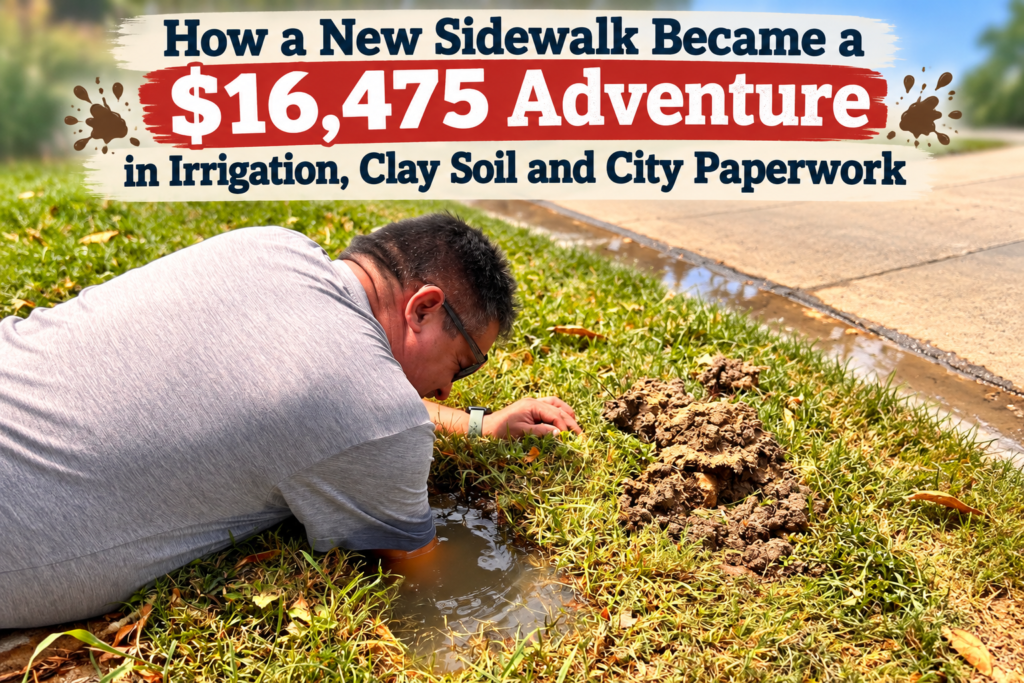
I’m generally pro-sidewalk. They’re great for walking. They keep pedestrians out of traffic. Dogs seem to enjoy them. But what I did not realize is that a sidewalk could potentially become the opening act in a story involving a destroyed sprinkler system, dead landscaping, doors that suddenly stopped closing properly, a structural engineer, 16 proposed foundation piers and, because this is municipal government, a Notice of Claim. So, naturally, I thought this would be a fun blog article to write. This is the story of what happened at the Dallas Maids office at 2606 Manor Way in Dallas, what our contractors found, and why I filed a property-damage claim with the City of Dallas.
A small but important disclaimer before we begin: the claim is still pending. We believe the sidewalk work and resulting loss of irrigation contributed significantly to the foundation problems we discovered. Our irrigation contractor was much less diplomatic about what happened to the sprinkler system. The structural engineer, however, documented the foundation problems and the importance of soil moisture but did not determine what caused the movement. In other words, I’ll stick to what the evidence actually says. Which, fortunately, is plenty.
It Started With a Sidewalk
Around the end of July 2026, a new sidewalk was installed along the front of our Dallas Maids property. Nothing particularly exciting there. We did not receive a message saying, “Good news: the sidewalk is finished. Slight complication: you may want to check everything buried underneath it.” So we carried on with life.
I can only assume the landscaping started looking increasingly unhappy as, living up north, I was not around to monitor it. Though when I returned a few months after may last visit, I noticed it and it wasn’t pretty. Shrubs and smaller plants along the building had dried out. My beautiful magnolia tree’s leaves were a mixture of green and brown color. Mostly brown. Our curb appeal, deactivated.
And when I walked in the building the first time after a few months, I noticed something else odd… a couple of doors in the office were no longer closing properly including my office door which now required a little muscle to open.
At first, these seemed like unrelated annoyances. Plants die. Doors get cranky. Dallas gets hot. Then we called Sam.
Enter Sam, the Sprinkler Detective
On September 2, our irrigation contractor, Sam Gonzalez of Xscapes Irrigation and Landscapes, came out to figure out why the irrigation system wasn’t working. This is where the story stopped being boring.
Sam found the irrigation water supply turned off. When he turned it back on, water started escaping near the newly installed sidewalk. So he started digging. And digging. The main irrigation line was broken on both sides of the sidewalk. More surprisingly, according to his written report, there wasn’t even a pipe remaining beneath the sidewalk connecting the two sides. The irrigation control wires had also been damaged.
Sam ran a new pipe beneath the sidewalk, reconnected the main line, repaired the wiring and got three zones operating again. Then the water came back on. Which revealed… more broken pipes. Multiple lateral irrigation lines near the sidewalk were broken too, requiring another repair visit on September 9. Apparently our sprinkler system had decided to recreate the hydrological cycle underground.

One of Sam’s messages said the damage was:
“definitely done when the new sidewalk was installed.”
And in a follow-up message, he was even less ambiguous:
“Yes they completely destroyed the system.”
I appreciate a contractor who doesn’t bury the lede.
The Pictures Were Pretty Convincing Too
Sam took photographs while making the repairs. They show excavated areas beside the new sidewalk, exposed PVC, damaged wiring, pooled water and broken irrigation components. One photograph shows an excavation directly at the sidewalk edge with water collecting below. Another shows a PVC elbow with visible damage along with damaged wiring.
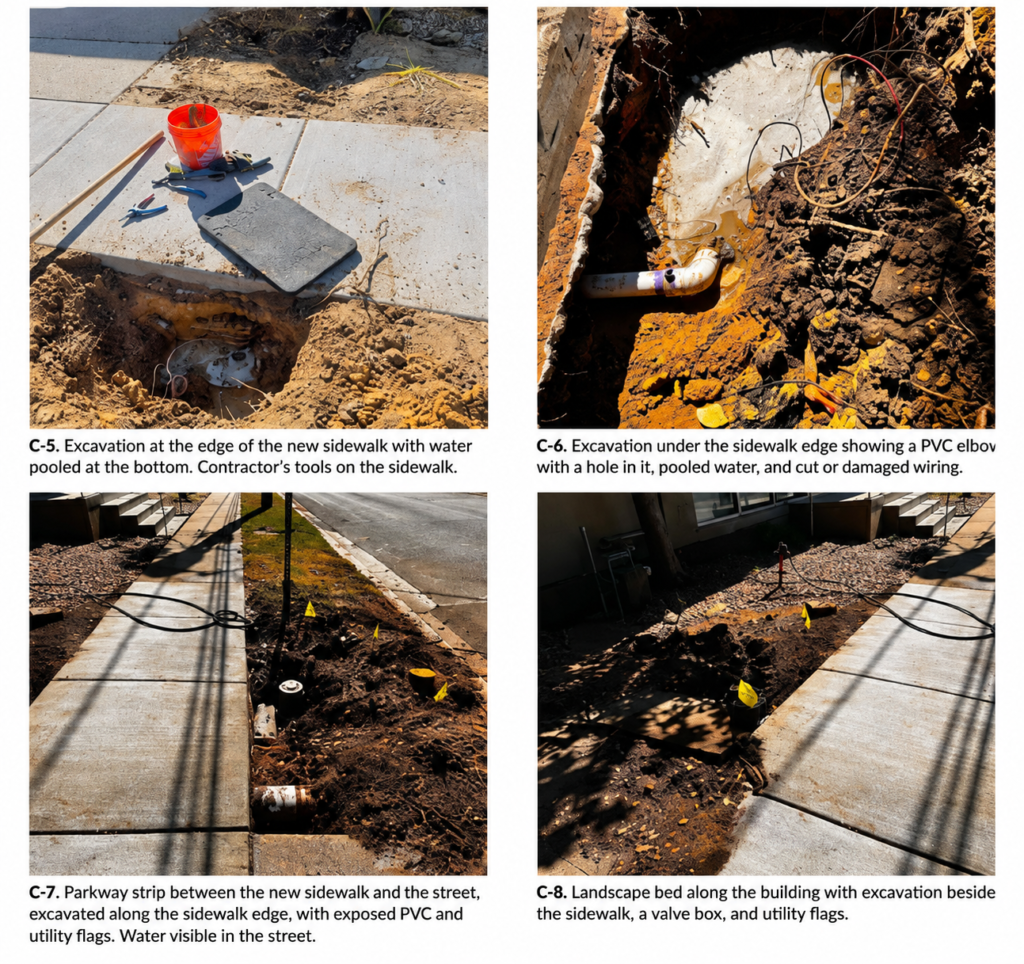
At this point, “sprinkler repair” had evolved into a small archaeological excavation. The actual irrigation repair wasn’t trivial either. Xscapes made two visits:
September 2: $1,375.32
September 9: $1,131.75
Total irrigation repairs:
$2,507.07
The second invoice documented another main-line break farther down the sidewalk, two lateral-line breaks, three damaged sprinkler heads and another break in a flowerbed. So this wasn’t one unlucky PVC fitting having a bad day.
And Then Things Got More Interesting
While all this was happening, there was another problem. Doors inside the office had started sticking and becoming difficult to close. Specifically, two doors running in the same general orientation began having problems around the same period. Now, I own cleaning companies. I am reasonably comfortable diagnosing dirty floors. But foundation movement is slightly outside our normal service menu. So we called people who actually know what they’re doing.
On September 23, Blackland Home Inspections performed a foundation inspection and elevation survey. A Texas professional engineer with Noble Engineering Services subsequently sealed the foundation evaluation on September 28. And that’s when the numbers got our attention.
Apparently 2.8 Inches Is Not Nothing
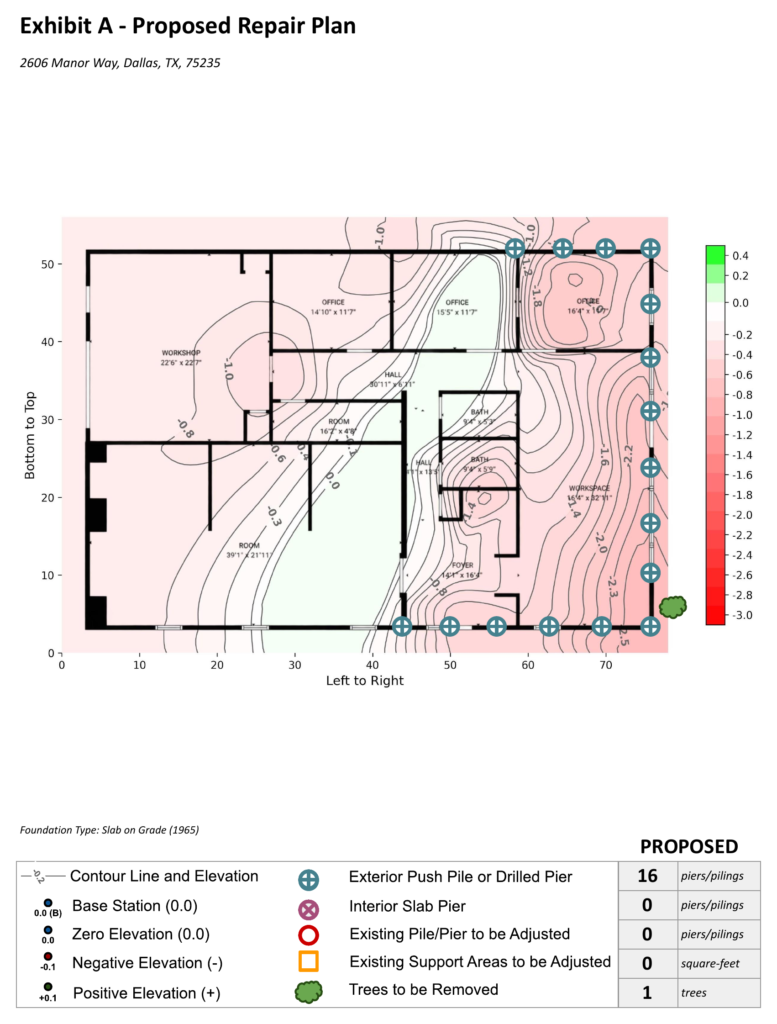
The elevation survey measured the highest portion of the slab at approximately +0.1 inch and the lowest at approximately -2.7 inches. That’s a 2.8-inch difference across the building.
The analysis examined 41 foundation deflection profiles. Fourteen failed the applicable limits. The worst was approximately L/160, compared with an allowable value around L/340. Now, I’m not an engineer, but even I understand that when one number is supposed to be around 340 and yours is 160, nobody is about to hand you a trophy.
The inspection also documented:
- significant exterior wall cracking
- doors rubbing, sticking or showing gaps
- minor drywall cracking
- other evidence consistent with foundation movement
The engineer concluded that there were clear signs of foundation issues and recommended stabilization as soon as practical, preferably within the next year. The proposed repair plan included 16 exterior piers.
Why Would Sprinklers Have Anything to Do With a Foundation?
This is where Dallas soil enters the story. Our building sits on expansive clay soil. The engineer’s report explains that foundation performance in this type of soil is heavily influenced by changes in moisture. Clay expands when moisture increases and shrinks when it dries. The report specifically discusses maintaining relatively constant soil moisture and recommends consistent watering during dry periods. In other words, irrigation around a Dallas foundation isn’t necessarily just about having attractive begonias. It can also be part of maintaining relatively stable soil conditions. However, and this distinction matters, the engineer did not determine that the damaged irrigation system caused the foundation movement. There was no previous elevation survey available for comparison, and the report also notes other factors capable of affecting foundations, including mature trees, grading, the age of the building and expansive soil itself.
Our claim is that the extended loss of irrigation following the sidewalk work was a significant contributing factor. And that is ultimately something the City’s claim process will have to evaluate.
The Tree Had Been There Longer Than Most Employees
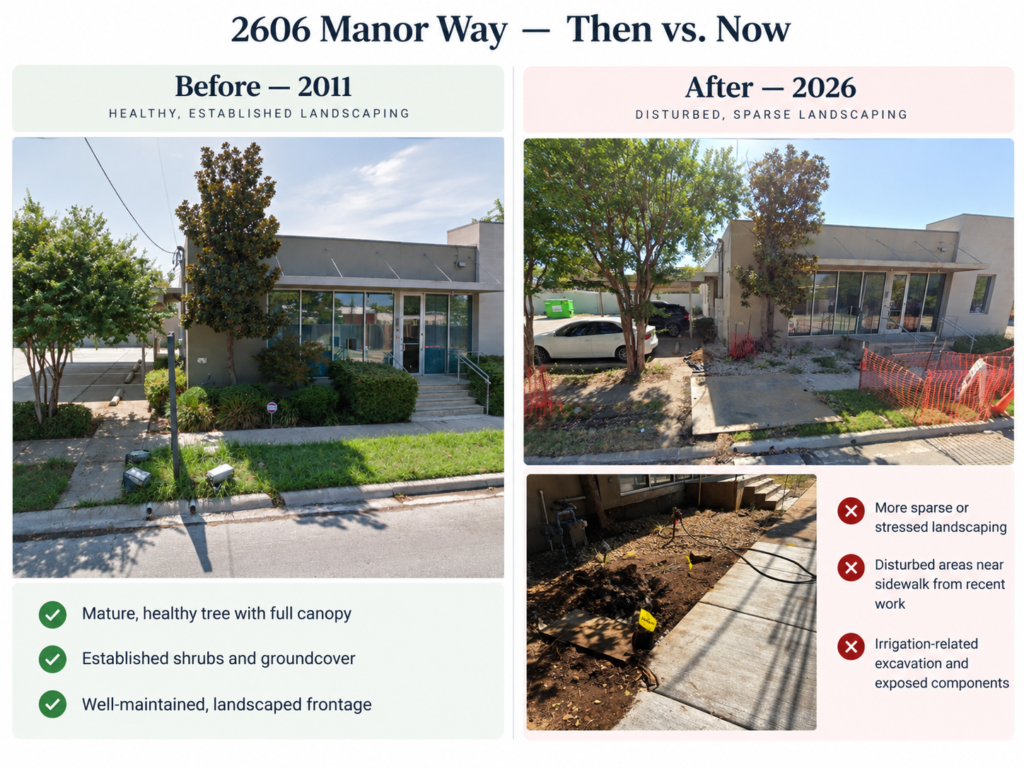
We also became concerned about a mature tree at the front of the property. Fortunately, Alex found an old Google Street View image from 2011 showing the same tree. So the claim package now includes photographic evidence that the tree has been there for roughly 15 years.
Then Alex Turned Into a Claims Department
At this point we had: sprinkler repairs, photographs, contractor text messages, invoices, dying landscaping, doors that didn’t close properly, an engineering inspection, elevation measurements and a proposed foundation repair plan. What I did not particularly want was a new hobby called, “Learn Dallas municipal claims procedure.” Fortunately, Alex handled the research and assembled everything for me. And I mean everything.
He put together a package containing:
- the City of Dallas Notice of Claim
- a full factual report and timeline
- the engineer’s foundation evaluation
- the irrigation contractor’s written statements
- screenshots of the contractor’s messages
- photographs taken during the sprinkler repairs
- the irrigation invoices
- the engineering inspection invoice
- historical and current property photographs
- a breakdown of the damages being claimed
He then sent me one refreshingly simple email essentially saying: Here is the form. Sign it. Here is the complete evidence package. Submit it. This is exactly how I prefer complicated administrative tasks to enter my life. Someone else converts chaos into a folder. I sign something.
So What Are We Claiming?
The current documented amount is $16,475.07, before the final landscaping costs are known. Here’s how it breaks down:
| Damage | Current amount |
|---|---|
| 16 proposed foundation piers | $10,000 |
| Tree removal allowance | $1,100 |
| Crack repairs | $1,500 |
| Door/window adjustments | $750 |
| Irrigation repairs | $2,507.07 |
| Engineering/foundation inspection | $618 |
| Landscaping replacement | TBD |
| Current claim | $16,475.07 |
Importantly, the engineer’s foundation numbers are budget estimates, not contractor bids, so the ultimate amount could change.
And Today, I Finally Hit Send
On October 6, 2026, I signed the Notice of Claim and emailed it to the City of Dallas Office of Risk Management along with access to the supporting documentation Alex assembled. My email was considerably less dramatic than this blog post. Basically: Here’s the claim. Here’s the evidence. Please confirm you received it.
This is probably why lawyers don’t hire me to write pleadings. Now we wait for the City to review everything. I’m interested to see what they conclude.
What I Learned From This
If construction is happening near your property, especially anywhere near irrigation, utilities or landscaping, document everything. Take pictures before the work. Test your irrigation afterward. Pay attention to landscaping changes. And if you discover damage, get the contractor who actually saw it to put their observations in writing. Sam’s contemporaneous photographs and written description are far more useful than us saying six months later, “we’re pretty sure the sprinklers worked before.”
The same applies to structural damage. Once we noticed the door problems, getting an independent foundation inspection gave us actual measurements instead of opinions. And organize the evidence. Dates, invoices, screenshots, photographs and professional reports tell a much better story than a frustrated property owner yelling, “but I swear the door used to close!”
The Story Isn’t Finished Yet
I don’t know how the City will respond. Maybe they’ll agree with us. Maybe they’ll disagree. Maybe somewhere in Dallas City Hall there’s already a person opening my 24-page evidence packet and thinking, “oh good. The sidewalk guy.” Eh, we’ll see.
What I do know is that what began as a perfectly ordinary sidewalk project ended with a sprinkler contractor excavating multiple broken lines, an engineer measuring 2.8 inches of elevation variation, a proposed 16-pier foundation repair and me learning considerably more about expansive clay soil than I ever intended.
The claim is now filed. I’ll plan on updating this post when we find out what happens next. Until then, I’m still pro-sidewalk. I’m just considerably more interested in what’s underneath them.
Update Oct, 8th: It was Atmos Energy!
The City of Dallas let me know that Atmos Energy was the contractor responsible for the work that caused the damage, so I’ve emailed claims@atmosenergy.com to open a claim. Apparently this has now moved from city paperwork to utility-company paperwork. Progress, I suppose.