
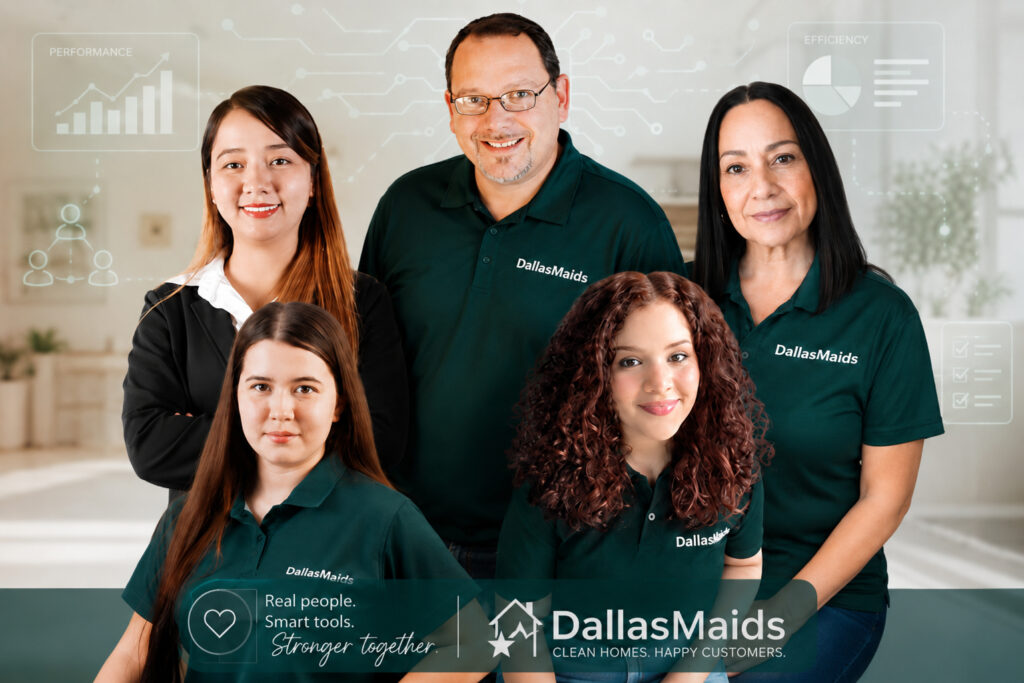
Are we implementing AI into our business? Yes.
Will AI take your job? No.
I wanted to write this because I know artificial intelligence (AI) is everywhere right now. It is on the news, in business articles, in software updates, and probably hiding somewhere in your toaster waiting to become “smart.” So I understand why people may wonder, “Is AI coming for my job?” Let me answer that clearly: no, that is not the plan.
A few months ago, a friend of mine who owns Atlanta Green Maids gifted me an amazing piece of software code that could analyze customer phone calls and produce useful KPIs for Dallas Maids using AI. We had our developer add it to our system, and frankly, what AI could do blew me away!
As a business owner, my first thought was, “How can this make our operations more efficient?” One of the ways it could help was by removing some repetitive, boring tasks from our staff. My reaction was not, “Great, now I need fewer people.” My reaction was, “Great, now I can move people into roles that better fit their natural strengths.” Because let’s be honest: nobody wakes up in the morning excited to do boring administrative work. Nobody says, “I hope today is filled with repetitive tasks that slowly drain my soul.” At least I hope not. If you do, we may need to have a separate conversation.
My goal was to take some of that work off people’s plates so they could focus on things they are better at and enjoy more. But when it came time to explain this, I felt uneasy. Even though I knew the change would improve the job, put people in positions where they could shine, and make the company stronger overall, I worried they might hear something different. I was afraid they might think, “Oh no. AI is taking my job.”
That was not what I meant at all. But I know this is a sensitive topic, and sometimes even good news can sound scary if it is not explained the right way. I found myself overthinking it, which made me sound more nervous than I should have. And when the person explaining the plan sounds nervous, that does not exactly scream, “Everything is fine.”
Later, I had a conversation with my business partner at Denton Maids, Troy, about AI and how it might affect the home cleaning industry. After talking it through, we both came to the same conclusion: AI will change some tasks, but it will not replace the human side of our business. Why? Because humans have something AI does not: the ability to connect with other humans on a more deep level.
Our customers want to feel heard. Our staff needs support, encouragement, coaching, and understanding. Problems need judgment. People need kindness. Sometimes a customer is not just asking a question; they are stressed, overwhelmed, moving, dealing with family issues, or simply having a bad day. AI can process information. It can summarize calls. It can help us spot trends. It can make us faster and more organized. But it cannot care. And caring matters.
I also know how I feel when I call a company and get trapped in an AI phone system instead of reaching a real person. It is not a warm, magical experience. It is usually me saying “representative” 42 times into the phone while questioning every life choice that brought me to that moment. That is not the customer experience I want us to provide.
So, in short: Our people need not worry about AI.
As we grow, there will be more work, not less. I will need the help of our staff. AI may allow us to avoid hiring extra expensive help for certain tasks in the future, but that makes the company stronger. And when the company is stronger, it creates more stability, better opportunities, and a healthier livlihood and future for everyone here.
We do need to embrace AI now, before our competitors do. If we can use it to become more efficient, more effective, and better at serving our clients, then we gain a competitive advantage. That helps us grow. It helps us survive. And in an economy that feels increasingly unstable, that matters. So, this is not about replacing people. This is about strengthening the business so we can protect the people who make the business work.
For our cleaning teams, I want to be honest. AI and robotics may eventually affect the cleaning side of our business. I have written about this before and I do think robots could someday handle more and more physical tasks needed for house cleaning. If this does happen, cleaning will probably be disrupted before office and support work because robots are better suited for repetitive physical tasks: vacuum this floor, mop that room, wipe that counter, repeat until battery dies or until it gets confused by a sock. But that does not mean human cleaners suddenly become unimportant.
Robots will likely take over cleaning in layers. They may start with the easiest, most repetitive work: floors, vacuuming, mopping, and simple surface cleaning. But the harder work such as detailed cleaning, deep cleaning, customer preferences, fragile items, clutter, pets, kids, special instructions, and the judgment that comes from experience, will be much harder to replace. A robot can learn how to clean a floor. But can it tell the difference between trash, a child’s school project, expensive makeup, medication, tax documents, or something the customer definitely does not want touched? That is where humans still have a major advantage.
So yes, the cleaning profession may change over time. I do not want to pretend otherwise. The future cleaner may eventually become more of a home-care professional, quality-control specialist, robot supervisor, detail cleaner, organizer, or customer-trusted service expert. But the best cleaners, the ones customers trust, request by name, and feel comfortable welcoming into their homes, will remain valuable much longer than people think.
Our job as a company is not to ignore the future. It is to prepare for it. If robots eventually become part of this industry, I want us to be the company that knows how to use them wisely while still protecting the human care, trust, and professionalism that built this business in the first place. Because whether the tool is a mop, a vacuum, a scheduling system, or one day a confused little metal butler, the heart of this business is still people.
The heart of what we do is still human. It is the care we show customers. It is the pride our teams take in their work. It is the judgment, kindness, and professionalism that no software can truly duplicate. So yes, we are implementing AI. But no, AI is not replacing you. And as long as we keep using technology to support people rather than replace them, I believe Dallas Maids will be better for it.

About the author: Greg Shepard is the founder of Dallas Maids, a professional home cleaning company he started in 2004 after a career in technology at IBM and Bank of America. A Baylor University graduate, he writes about entrepreneurship, business, and the observations and lessons he has picked up along the way.